Item values & hidden clauses
The seller can see the lot’s real market value and both randomized clauses. Buyers cannot. A visible object name or another player’s winning bid is not enough to price your current lot: its clauses and your cash position matter too.
The most useful question in a Double Dealers auction is “what can I safely pay for this lot?” The seller sees the item’s real market value and its two clauses. You, as a buyer, must decide with less information. A beautiful object, a confident pitch and an energetic bidding war can all distract from that gap.
This guide gives you a way to separate visible prices, uncertain effects and your own budget. The numerical examples are hypothetical teaching examples, not a list of in-game item values. Read the actual lot’s text when it becomes available; another auction’s outcome does not replace it.
Four numbers that mean different things
An item can have a market value, an auction price, a current proposed bid and a later selling offer. They answer different questions. Treating them as interchangeable is an easy way to believe you have found a bargain when you have only found a number.
| Number | What it tells you | What it does not settle |
|---|---|---|
| Real market value shown to the seller | Information the seller can inspect about the lot | Whether its clauses make it suitable for you |
| Current highest bid | What someone has already offered during this auction | Whether the purchase will produce profit |
| Proposed next bid | The amount you are about to submit | The amount you have already spent |
| Current selling offer | The cash the game currently offers for an owned item | Every possible future bonus or clause interaction |
The official description confirms the seller’s access to the real value and two hidden clauses, with buyers lacking that full information. It does not supply a universal public resale formula for every situation. If a value is hidden from you, leave it uncertain rather than substituting the seller’s claim as if the game had confirmed it.
Read the buyer interface before bidding
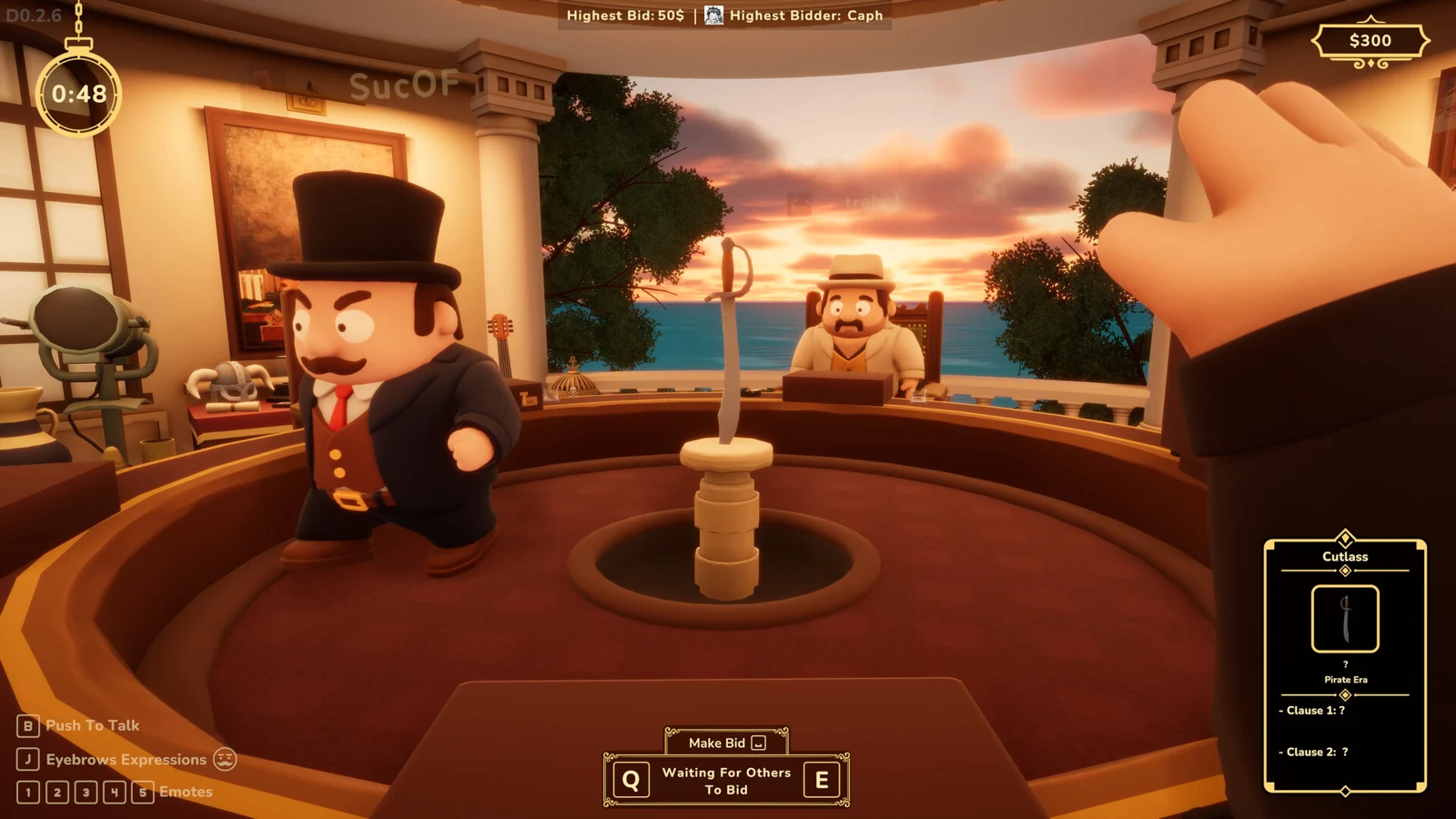
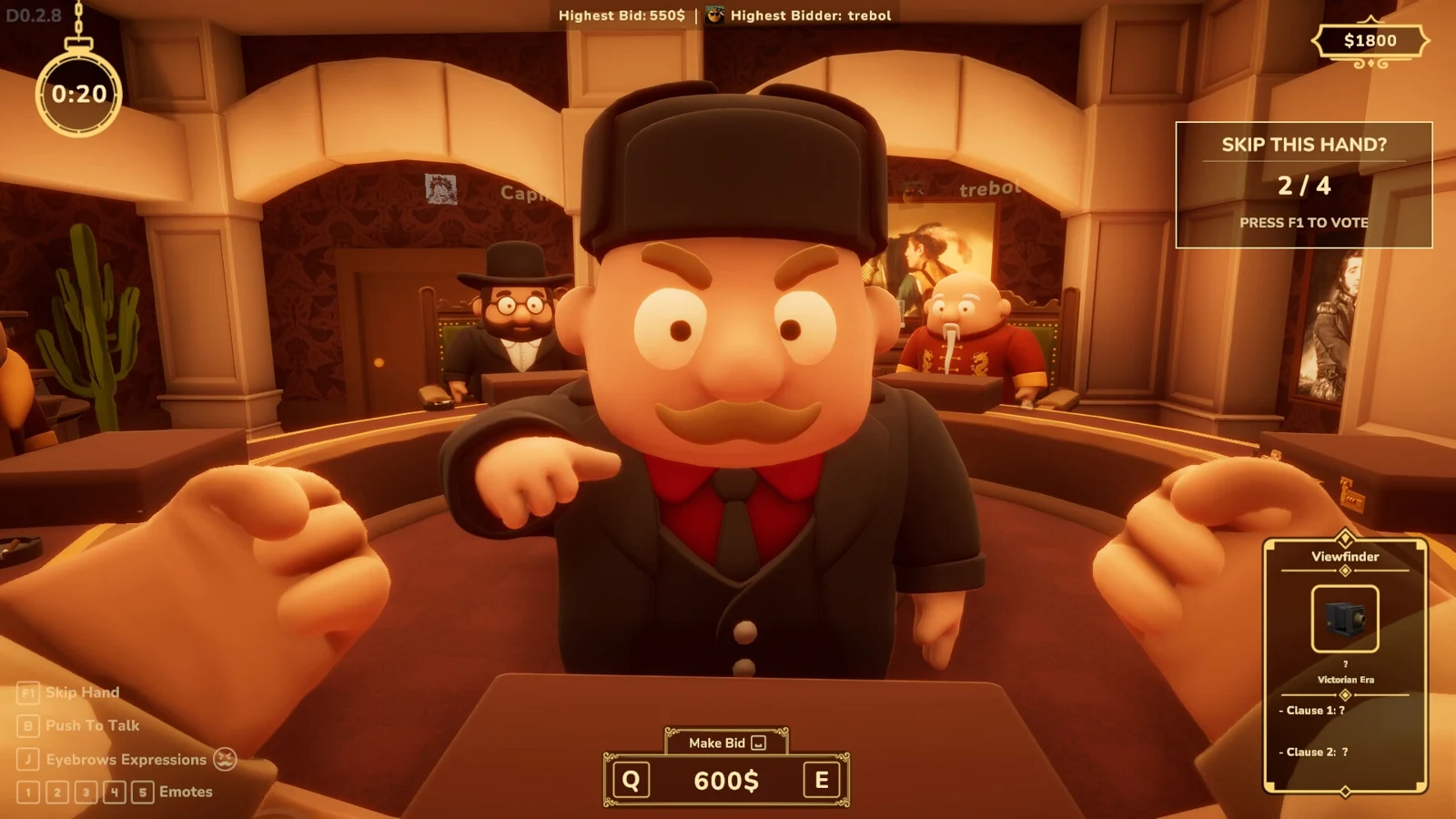
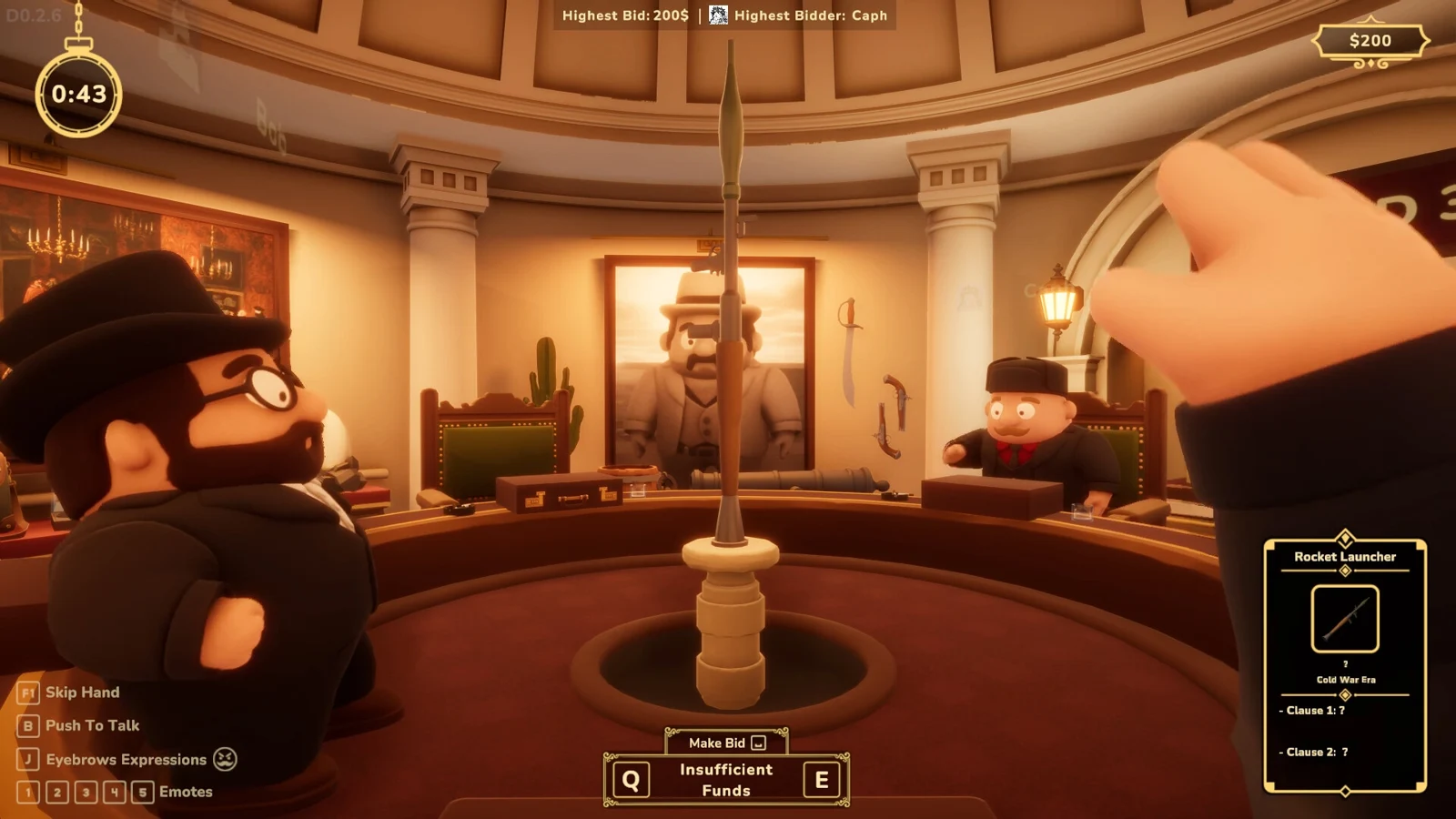
Official gameplay shows a timer, highest bid and bidder, a cash display and a proposed bid. The pictured lot also has a named item, an era label and two clause fields containing question marks. Those question marks are part of the information problem; they are not a missing price guide on another website.
In the main screenshot above, the highest bid is $550 while the proposed next bid is $600. The cash display says $1,800. Those numbers describe that captured moment in an older official build. They do not establish the Viewfinder’s fixed value, the current starting balance, or the universal size of a bid increase.
Before pressing a bid control, check the actual amount you will submit and the money you would have left. When several players are speaking, it is easy to remember the last price you heard rather than the latest value on screen. A brief look at the interface can prevent an expensive misunderstanding.
What hidden clauses change
Each item has two randomized clauses. The announced rules allow beneficial and harmful effects; they can change whether a seemingly attractive lot fits your plan. You are buying the item together with its terms, rather than choosing a plain object and adding only the clauses you like afterward.
Read both. An appealing first clause can distract you from an unfavorable second one. When the text is revealed, look for the action that triggers the effect, the player it affects, the timing, and any limit or exception. “This item has a bonus” is not yet an explanation of when that bonus appears or who receives it.
These questions are useful for interpreting the actual wording:
- What must happen for this effect to apply?
- Who gains or loses something when it applies?
- Does it happen immediately, later, or only under a stated condition?
- Does keeping, selling or transferring the item matter?
- Is there a cap, target restriction or other qualification?
- What does the second clause add to that situation?
These are reading questions, not a claim that every clause has all six features. Some text will answer only part of the list. If the rule is ambiguous, do not invent an interaction from the clause’s name. Keep the exact wording and ask for clarification with the build number.
Why there is no safe fixed price shortcut
An object’s visual identity is not enough to evaluate the current transaction. You still need the value and the effects on this particular lot, plus a plan for what you will do with it. A table saying “camera equals $600” would not tell you whether to pay $600 for a lot whose terms you have not seen.
The randomization stated by the developer applies to the clauses. That alone is enough to make a same-looking item an unreliable shortcut to a profitable bid. It does not justify claiming that every base value is random, or that all copies of an object must share the same value. Keep those separate until the current build establishes the underlying item rules.
Likewise, a winning bid from a video is a record of what those players chose. It is not the seller’s valuation or the final market result. If you keep notes from footage, record the role, build, visible value, clause text and outcome separately. A row containing only the object and winning price is missing the information that explains the result.
Set a cash ceiling first
Start with cash you can spend. Choose how much you want left after the purchase, then subtract that reserve from your current balance. This produces a cash ceiling: the most you are allowing yourself to spend on this auction without breaking that reserve.
For a hypothetical $2,000 balance and a chosen $700 reserve, that ceiling is $1,300. It is not a recommendation to bid $1,300. It simply marks the boundary imposed by your own cash plan. Your assessment of the lot can call for a lower ceiling, and the next auction can give you a reason to revise the reserve before bidding begins.
Do not count an unclaimed bonus or an unsold item as cash already available. If your plan requires a later sale, inspect that sale in the market rather than treating an estimate as spendable money now. Cards also compete for cash, so include any intended card purchase before using the whole remainder on a lot.
Set a value ceiling separately
The second ceiling asks what you are willing to pay for the deal, given the information available. As a buyer, the lot’s true value and clauses may still be hidden. You cannot calculate a trustworthy exact expected return without knowing the possible outcomes and their likelihoods.
Instead, compare plausible cases and decide how much uncertainty you can tolerate. Consider an acceptable outcome, a disappointing outcome and a case where a clause creates a complication. Use assumptions you can explain. A seller’s repeated praise is not a numerical probability, and three memorable wins do not establish the odds of the next lot.
Your final bid limit should respect both ceilings: you should not exceed the amount you can afford to commit, or the amount you think this uncertain deal is worth. The cash ceiling protects your next move; the value ceiling protects you from paying too much for the current one. They serve different purposes even if they happen to produce the same number.
Keep the reserve practical. An enormous reserve can leave you passing on every lot, while no reserve at all can make one purchase decide your remaining options. There is no announced universal percentage that makes this choice for you. Start with the cash you want available for the next concrete action, such as another bid or an intended card, and judge the current lot with that constraint visible.
You can revise a plan when useful information appears. The important difference is between revising it for a reason and raising the limit simply because the auction is exciting. If you choose a higher limit, identify what changed: a claim you found credible, a cash requirement you no longer have, or a risk you consciously decided to accept. That will give you something to review after the reveal instead of a vague memory of wanting to win.
Worked example: the tempting bargain
Imagine a hypothetical auction where you have $2,000, want $700 left, and choose $600 as your maximum for this uncertain lot. The seller claims it will sell for $900, but you cannot see the real value or the clauses. Your cash ceiling is $1,300; your chosen value ceiling is $600. The binding limit is $600.
If you buy at $500 and later receive a $900 selling offer, the simple price difference is $400. If the offer is $450, the difference is minus $50. Those figures leave out clause effects and other transactions. They demonstrate why you should compare the actual purchase and selling amounts instead of calling every auction win a profit.
If the next submitted bid would be $650, stop even though you have enough cash to pay it. Nothing about your spare cash proves the seller’s $900 claim. Raising your limit because another player wants the lot changes your decision without adding reliable information about its terms.
After the reveal, update your understanding. If you discover a condition that materially changes the result, note that condition. Avoid reducing the lesson to “this object is good” or “this object is bad.” The useful lesson is which detail made the transaction different from your expectation.
Worked example: cash wins over a possible bonus
Suppose you hypothetically own an item after the auction, have $200 left and see a $500 selling offer. Selling would produce $700 in cash before other effects. Holding preserves the item and its potential benefit, but leaves the $500 outside your usable cash balance.
If your next plan needs $600 of cash, holding creates a constraint regardless of how impressive the item looks. You can change the plan, sell, or pass on the next purchase. What you cannot do is budget as though you both sold the item and kept it for the bonus at the same time.
This is why purchase planning and market planning belong together. A lot that fits one player's cash position may not fit another's. There is no need to assume one player is irrational simply because they stop at a lower bid. They may be reserving money for something you cannot see, or accepting less uncertainty than you are.
For the market side, use the sell-or-hold checklist. It keeps the current cash offer separate from a potential later benefit.
Ask questions that expose the decision
Useful buyer questions focus on the parts of the deal the seller knows and you do not. Ask what makes the item attractive, what could make it awkward to keep, and why the seller chose it instead of another item. You are looking for a claim that helps you decide, rather than trying to force a guaranteed confession.
A specific answer can be checked after the reveal. “It is worth a fortune” gives you little to compare. “The important benefit depends on holding it” gives you a concrete statement to evaluate, although it can still be misleading. Remember whether the seller described a base value, a possible benefit or a certain cash return.
Avoid treating silence as a game rule. A quiet seller could be bluffing, distracted, unsure, or unable to use voice chat. Likewise, a confident seller could have a strong lot or be good at presenting a weak one. Social cues can influence a judgment, but they do not replace the displayed terms.
Keep questions brief enough to watch the timer and bid amount. Choose the one that matters most to your decision.
Listen without surrendering your limit
An excited rival can make an item feel scarce and valuable. The rival may have a plan, may be bluffing, or may simply want to win. None of those possibilities independently confirms the lot’s value for you. Use another bid as information about the auction’s current price, not as permission to ignore your own ceiling.
Do not submit a bid purely to punish the rival. If they stop, your bid can win and the uncertain lot becomes your purchase. Price pressure is still a financial commitment. Before every increase, ask whether you would accept owning the item at that amount if nobody else bids again.
The same caution applies when the seller says this is your last chance at a bargain. A timer creates urgency, but it does not make the hidden terms less risky. If you cannot read the number or make a reasoned choice in time, passing can preserve a clearer decision for later.
Choose a lot as the seller
Your seller turn begins with information the buyers lack. Compare the three starting items together with their values and clauses. Think about what you want from the sale: usable cash, an opportunity to sell into demand, or a different exposure in your inventory.
Do not assume that the highest displayed value is always the best item to sell first. That is a possible starting point, but the clauses and your broader plan matter. You may value an item’s future role, prefer to release money tied up in another item, or find that the table is currently interested in a particular kind of purchase.
The description confirms that you choose an item to auction; it does not establish every minimum-price, refusal or no-bid rule. Read the current prompts and match settings for those cases. Plan your pitch around rules you can actually inspect instead of building a strategy on an assumed cancellation option.
Make a coherent seller pitch
A coherent pitch gives the buyer a reason to consider the lot. You can describe an attractive feature, respond to the room’s questions and choose which aspect of the deal to emphasize. Double Dealers is built around bluffing, so buyers should evaluate those claims rather than treating your speech as certified item text.
Give the pitch an objective: cash for your next move, rather than a record-breaking sale at any cost. A modest sale can still improve your position.
Watch what the table responds to. If a buyer is conserving money, louder praise may not change that constraint. If a buyer misunderstands which number is being discussed, clarifying the subject can be more effective than extending the pitch. Social pressure and actual affordability are different influences.
Once the auction resolves, examine the revealed terms and sale outcome. Compare your intended pitch with the response it produced. The result gives you feedback on this table, rather than a universal guarantee that the same line will work next time.
Evaluate a revealed lot without rewriting history
After buying, separate the information available before the bid from the information you learned afterward. A bad outcome does not automatically mean the earlier decision ignored obvious evidence; a good outcome does not prove an unlimited bid would have been sensible.
Record what you paid, the actual revealed value, the two clauses and what you chose in the market. If the result differed from your expectation, identify the specific gap. Did you misread the proposed bid? Trust an unsupported claim? Forget to reserve cash? Or accept uncertainty deliberately and get an unfavorable outcome?
These distinctions help you change the right habit. Misreading a bid calls for checking the interface. A misunderstood clause calls for slower reading. A cash shortage calls for a reserve. Simply declaring that you need to “play better” does not tell you what to do in the next auction.
Common traps and their corrections
| Trap | What to do instead |
|---|---|
| “Someone paid $800 for it in a video” | Treat that as a historical bid, then inspect your current lot |
| “The seller promised $1,000 back” | Ask what number and condition the claim refers to |
| “I can afford the next bid” | Check whether you also think the deal is worth that bid |
| “I will win the money back later” | Budget only cash and benefits you can justify |
| “One good clause cancels any bad clause” | Read both effects and their actual interaction |
| “Holding is always better” | Compare the current sale offer with the cost of tied-up cash |
| “I am bidding only to raise the price” | Be prepared to own the lot at every amount you submit |
Do not add imaginary certainty to solve these traps. A made-up percentage for a harmful clause or a made-up universal price multiplier makes a calculation look precise without making it reliable. Leaving an unknown visible is more useful than basing several further decisions on an invented input.
When an item or clause seems wrong
First compare the result with the exact wording and your current build. A screenshot from the demo may show rules that changed later. The developer acknowledged some card and clause issues during the early demo, but that history does not establish that your current interaction is a bug.
If you can reproduce an unexpected result, capture the item, both clauses, game phase, relevant action and build number. Preserve the sequence before testing several alternatives. Report what happened and what the wording led you to expect. Keep any requested game logs private, using the official support procedure.
If the interface itself is unclear, avoid doubling down financially on the same assumption. Let the current lot go, inspect the next reveal, or ask the developer. A question about how a rule works is a valid reason to slow down; it is not a reason to invent the rule from an item’s appearance.
A repeatable auction routine
Before the lot opens, check cash and choose a reserve. During the pitch, identify what is confirmed and what is merely claimed. Set a limit for the uncertain deal. When submitting a bid, reread the actual proposed amount. Stop when the next bid breaks your limit.
After the reveal, read both clauses. At the market, compare selling and holding with the cash needed for another auction or card. After the match, review one decision that taught you something specific. This routine is deliberately small enough to remember while several people are talking.
The player discussion about motivation to bid shows how confusing the game can feel if objects seem randomly priced and seller speech seems irrelevant. The useful starting point is the information asymmetry: the seller can see terms the buyer cannot, and conversation becomes part of how the buyer judges that uncertainty.
For the complete round order, read your first auction. For money reserved for a shop purchase, read cards and cash. Keep the same distinction throughout: a price you can see, a claim you can hear, and an outcome you have not yet learned are three different inputs to your decision.